The Short Answer
For a straightforward residential asphalt driveway in the Cincinnati area, most work lands between roughly 4 and 8 dollars per square foot installed. A typical two-car driveway of 600 to 800 square feet therefore falls somewhere around 3,000 to 8,000 dollars.
That is a wide band, and it is wide honestly. Published national cost guides put the figure anywhere from 3 to 13 dollars a square foot. The spread is not sloppiness on their part — it is the difference between laying new asphalt over ground that is already sound and tearing out a failed driveway to rebuild it from the subgrade up. Those are two different jobs that happen to share a name.
Everything below is what moves a driveway from one end of that band to the other, and how to work out roughly where yours sits before anyone comes out.
What Actually Drives the Cost
Square footage, which matters least of what you'd expect
Size sets the floor and almost nothing else. Doubling the area does not double the price, because mobilization — getting a crew, a truck of hot mix and a roller to your address — is much the same whether the drive is 400 square feet or 900. Small jobs carry that fixed cost on fewer square feet, which is why a short city driveway often prices higher per square foot than a long suburban one.
What is underneath, which matters most
The base is the part you are really buying. Around Cincinnati that matters more than it does in most of the country, because much of southwest Ohio sits on heavy clay — ground that holds water and changes volume as it wets and dries. How an asphalt section is built explains why the layer underneath decides the lifespan; for pricing, the point is that it is also the layer a cheap quote leaves out.
A driveway going down over a properly graded and compacted stone base is a predictable job. One going down where the base has to be excavated, replaced or deepened first is a different price entirely, and the extra stone is not where you want a contractor economizing.
Whether the old surface comes out
Tearing out old asphalt commonly runs about 1 to 2 dollars per square foot. Breaking out old concrete is harder and typically runs 2 to 3. In the older neighborhoods a fair number of drives are concrete, so a quote that looks high next to a neighbor's may simply be carrying a demolition line the neighbor did not need. Ask for it as its own line.
Access, and the hills
Cincinnati is genuinely hilly and that shows up in the price. On a steep grade the mix wants to move while it is still hot, so laying and rolling is a slower, more careful sequence. If a paver and roller cannot physically reach the top of a drive, some of the work becomes manual, and manual work costs what manual work costs. Tight side-yard access, retaining walls and mature trees near the edge all do the same thing.
Drainage
Where the water goes is a design decision with a price attached, and on a slope it is the one most often left out of a cheap bid. Detailing edges and pitch correctly costs something up front; correcting an undermined edge afterwards costs considerably more, because by then it is a repair rather than a detail.
A Worked Example — Estimate Your Own
Measure the drive, multiply, then adjust. It will not be exact, and it will tell you within a reasonable margin whether a quote you have been handed is in the right postcode.
- Measure it. Length times width, in feet. A common two-car driveway runs about 20 feet wide by 30 to 40 feet long — call it 600 to 800 square feet.
- Pick a rate. Sound base, straightforward access, standard residential build: 4 to 8 dollars per square foot.
- Multiply. 700 square feet at 4 to 8 dollars gives roughly 2,800 to 5,600 dollars.
- Add tear-out if the old surface is coming up. 700 square feet of asphalt removal at 1 to 2 dollars adds 700 to 1,400. Concrete removal at 2 to 3 adds 1,400 to 2,100.
- Add base work if the ground is bad. This is the line nobody can guess remotely, and it is the one most likely to move the total.
So a 700-square-foot replacement over an existing asphalt drive on decent ground reasonably lands somewhere near 3,500 to 7,000 dollars. If a quote comes in far under that, the question is not whether you are getting a deal — it is which of those steps is not in the price.
New, Resurface, or Replace — Three Different Numbers
These get used interchangeably in conversation and they are not the same thing.
- Overlay or resurface — roughly 2.50 to 4.50 dollars per square foot. New asphalt laid over the existing surface. No excavation, no new base. Cheapest by a distance, and only correct when the base underneath is genuinely sound.
- Full replacement — roughly 4 to 8 dollars per square foot. Old surface out, base corrected or rebuilt, new asphalt laid and rolled. What alligator cracking and persistent settling call for.
- New construction on bare ground — similar to replacement, sometimes more. No tear-out, but usually more excavation and grading because nothing has been shaped yet.
The overlay is where money gets wasted in this trade. Laid over a base that has already failed, it cracks along the identical lines within a season or two — you paid for a surface and the problem was never the surface.
Maintenance Costs, Which Are Small
- Sealcoating — roughly 200 to 600 dollars for a typical residential driveway, depending on size and how much prep the surface needs. Per-square-foot figures in published guides range from about 15 cents to a dollar, a spread wide enough that asking for a total on your actual driveway is more useful than arguing about the rate.
- Crack filling — roughly 1 to 3 dollars per linear foot.
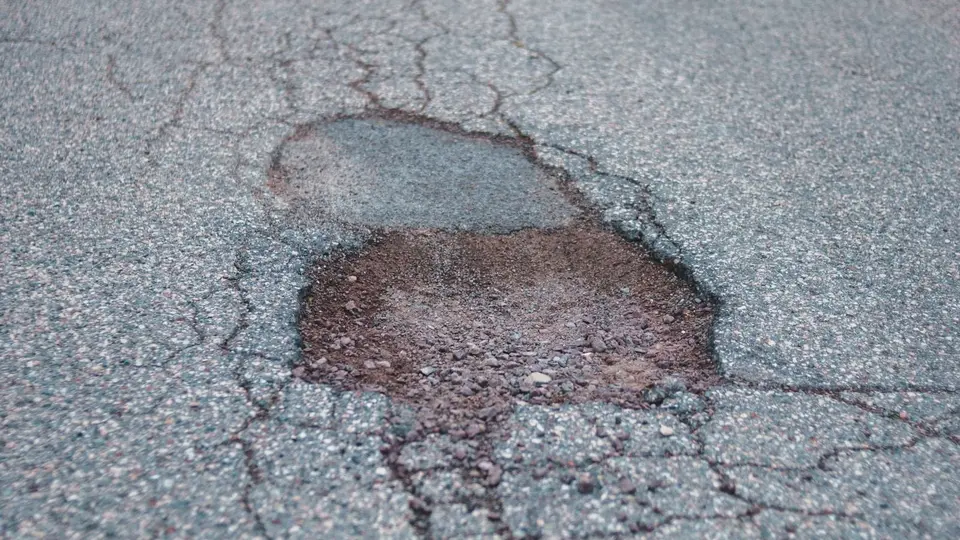
- Pothole patching — commonly 50 to 200 dollars each, depending on depth and whether the failure is in the surface or the base.
These are the cheapest numbers on this page and they are the ones that decide what the expensive numbers look like in five years. In a climate that crosses the freezing point as often as this one does, a crack sealed in September is a crack that does not spend the winter taking on water, freezing, and widening a little on every cycle. Sealed in March, the winter already happened.
Cincinnati-Specific Factors
Winter shortens the interval between spends
The local climate does not change the rate card so much as it changes how often you are back on it. Repeated crossings of the freezing point work water into anything already open, and de-icing chemicals extend that process further into the shoulder seasons. The financial consequence is simple: skipped maintenance here converts into structural repair faster than it does in a milder climate, and structural repair is several times the price per square foot.
Budget accordingly. A few hundred dollars of crack filling on a schedule is what keeps a driveway off the replacement line for a decade. The mechanism is explained on the sealcoating page, which is where that decision actually gets made.
Clay subgrade
Clay holds water and changes volume with it, so the ground moves seasonally under whatever sits on it. The cost consequence is stone: local jobs generally want more base than the same driveway would need on sand. That is the line item most likely to differ between two quotes that show the same total, and it is the one worth reading first.
The apron
Work at the street end can fall under the local authority rather than being purely yours to arrange, and what that involves is not uniform across the county. Treat it as a possible line on the quote and a possible delay on the schedule, and get it confirmed for your address before work is booked.
How to Read a Cheap Quote
A low number is not automatically a bad one. It is a question, and there are four places the answer usually hides.
- Base depth and asphalt depth, as separate figures. "Standard" is not a specification. This is the single most common place two quotes stop describing the same job.
- Is the old surface being removed or covered? An overlay priced as a rebuild is the most expensive misunderstanding available in this trade.
- What happens to the water. Pitch, edges, and where runoff is meant to go.
- Who handles the apron if the work touches the right of way.
A contractor comfortable putting the section in writing is telling you something useful before a shovel moves.
When Paving Is the Wrong Call
Occasionally the honest answer is to spend less. If the surface is sound and simply looks tired, sealcoating and crack filling for a few hundred dollars buys years and a full replacement buys very little. If the drive is heaving over a tree root, paving over it puts the split back along the same line inside two summers — the root is the job, not the asphalt. And if the base has failed under only one section, a full-depth patch on that section is a fraction of a rebuild.
A quote that never mentions any of these options is not necessarily wrong. It is worth one question.
Where These Numbers Come From
The ranges on this page are drawn from published national cost guides, cross-checked against each other, and stated as ranges because that is what they honestly are. Where the sources disagree — and on sealcoating they disagree by a wide margin — that disagreement is described rather than averaged away.
None of it is a quote. These are market ranges to calibrate expectations and to give you a basis for comparing bids on equal terms. The price for your driveway comes from someone standing on it.
Driveway cost guide — FAQ
What does an asphalt driveway cost in Cincinnati? For a straightforward residential replacement on a sound base, most work lands between roughly 4 and 8 dollars per square foot installed, which puts a typical two-car driveway in the 3,000 to 8,000 dollar range. National cost guides quote anywhere from 3 to 13 dollars per square foot, and that spread is not noise — it is the difference between an overlay on good ground and a full tear-out and rebuild on bad ground. The number is only real once someone has seen the site.
Why do online cost guides disagree so much? Because they are quietly describing different jobs. A guide quoting 3 dollars a square foot is usually pricing an overlay: new asphalt laid over an existing surface, no excavation, no new base. A guide quoting 13 is pricing a full rebuild with tear-out, stone, and a thick mat. Both numbers can be honest and neither tells you what your driveway costs, because the question that decides it — what is underneath — is the one a web page cannot answer.
Is resurfacing cheaper than replacing? Substantially, when it is the right call. Overlays typically run about 2.50 to 4.50 dollars per square foot against 4 to 8 for a full replacement. The catch is that an overlay only works when the base underneath is still sound. Laid over a base that has failed, it cracks along the same lines within a season or two and you have paid twice. Anyone quoting an overlay should be able to say why they believe the base is good.
What does sealcoating cost? For a typical residential driveway, roughly 200 to 600 dollars depending on size and how much prep the surface needs. Per-square-foot figures in published guides range from about 15 cents to a dollar, which is a wide enough spread that a total for your actual driveway is the more useful number to ask for. It is maintenance, not repair — it will not fix a crack that is moving.
How much is crack filling or a pothole repair? Crack filling generally runs about 1 to 3 dollars per linear foot, and individual pothole patches commonly fall between 50 and 200 dollars each. Small numbers, and they are the cheapest work in this trade by a wide margin — which is the argument for doing them in the fall rather than watching a hairline become a finger-width gap over one Ohio Valley winter.
Does removing the old driveway cost extra? Usually yes, and it is a line item worth seeing separately. Tearing out old asphalt commonly runs about 1 to 2 dollars per square foot; breaking out old concrete is harder and typically runs 2 to 3. In older Cincinnati neighborhoods a fair number of drives are concrete, so a quote that looks high against a neighbor may simply be carrying a demolition line the neighbor did not need.
Why will nobody quote it over the phone? Because the two things that decide the price cannot be seen down a phone line: the condition of the base, and access. Whether the ground holds water, whether an old surface has to come out, whether a truck and roller can physically reach the top of a steep drive — those change the number more than square footage does. A firm price given sight-unseen is either padded to cover the unknown or is going to change once work starts.
More on paving in Cincinnati
Request a free written quote
Tell us the address and what you are looking to have done. Ask for the quote in writing with the thickness and the base work spelled out, so you can compare bids on the same terms.
Prefer to talk it through? Call (513) 586-4731.