Diagnose First — What Failed Decides What It Costs
Every asphalt repair decision comes down to one question: did the surface fail, or did the base fail? Everything about the right fix and the right price follows from the answer, and the answer is usually readable off the pattern.
Straight cracks running roughly parallel
Usually thermal and age-related — the mat contracting and expanding through the seasons, or a reflection of a joint underneath. The base is generally fine. This is crack filling.
Cracks along the edges
Unsupported edge, often with a wheel regularly tracking over the same spot, sometimes with soil washed away from behind it. Fixable, and worth also fixing whatever removed the support.
The interconnected pattern that looks like reptile skin
Alligator cracking. The base has failed and the surface is flexing without support. This does not get filled, sealed or overlaid — all three hide it for one season and change nothing. It needs full-depth repair.
A depression that holds water
Something below has settled or washed out. The puddle is the symptom. Filling the low spot with new asphalt without correcting what settled produces the same low spot again.
A crack that returns along the exact same line
The most diagnostic thing on this list. Something underneath is moving — saturated clay swelling and shrinking seasonally, a tree root, or a utility trench that was backfilled without proper compaction. Repeating a surface repair on it is repeating a mistake.
Crack Filling
Cheapest work in this trade and the highest return, because it stops water reaching the base.
The threshold worth acting on is roughly a quarter inch. Narrower than that and a sealcoat will generally cope. Wider and it needs filling on its own before anything goes over the top.
Timing carries unusual weight in this climate. What damages pavement here is not the depth of cold but the number of times the temperature crosses freezing and back, and this region spends much of the winter oscillating across that line. Water gets in, freezes, expands, and leaves the crack a little wider than it found it. Repeat that a few dozen times a season and a hairline in October is a finger-width gap by March.
Which makes the September pass worth more than the March one. Sealed before winter, the path is closed. Sealed after, the winter already happened.
Pothole Repair, and the Difference Between Filling and Fixing
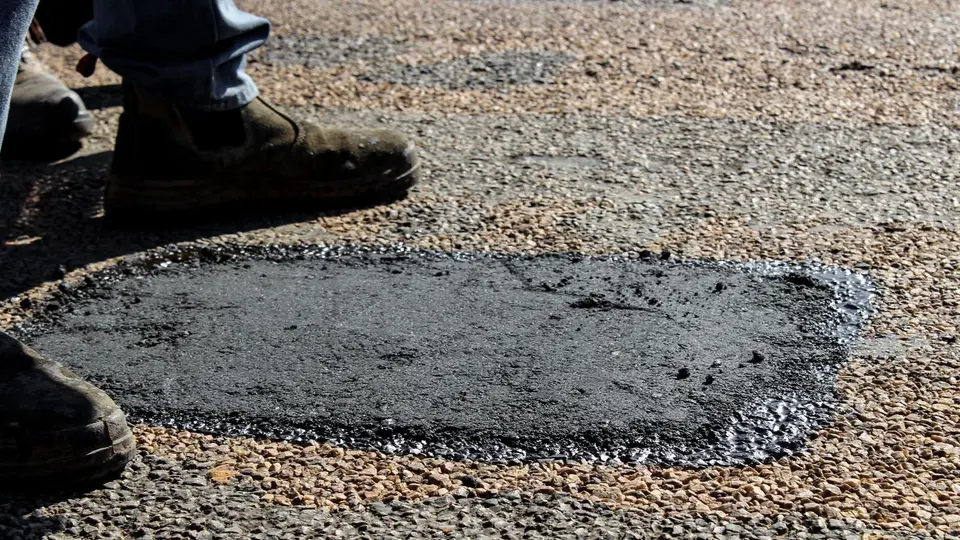
A pothole is the last step in a process that started as water getting under the surface, washing fines out of the base, and hollowing out the support until the unsupported surface collapsed.
That matters because it tells you what a repair has to do. Shovelling material into the hole and tamping it — a throw-and-go patch — restores the shape and does not restore the support. It is legitimate as a temporary measure in the middle of winter when no plant is open, and it should be described as temporary rather than sold as a repair.
A proper repair is full-depth: saw-cut the failed area back to sound material in a clean rectangle, excavate down through the failure, correct or replace the base underneath, then rebuild the section and compact it. It costs more and it does not come back next spring.
The tell that you are being offered the cheap version is the absence of any mention of what is under the hole.
Patching a Section vs. Replacing the Drive
This is where the money decision usually sits, and the honest answer is often the cheaper one.
- Isolated failures — patch. One bad corner, one settled area, one stretch of alligator cracking, with the rest of the surface sound. Cut it out, fix the base, rebuild it. A fraction of a replacement.
- Widespread alligator cracking — replace. When the pattern has spread across much of the surface, the base has failed generally rather than locally, and patching becomes an annual subscription.
- Sound base, tired surface — overlay. New asphalt over the existing surface, which only works when the base underneath is genuinely sound.
The rule that holds: overlay if the base is sound, replace on widespread alligator cracking. Anyone quoting an overlay should be able to say why they believe the base is good, and there are good answers to that question.
Driveway Repair That Turns Out Not to Be Asphalt
Worth naming because it causes real confusion locally. A lot of Cincinnati driveways, particularly in the older neighborhoods, are concrete. Concrete problems — a slab that has settled, a lifted section, a cracked panel — are a different trade with different equipment and different techniques, and are not repaired with asphalt.
If the surface is a poured slab with joints in it rather than a continuous black mat, an asphalt contractor is generally the wrong first call. Saying so up front saves everyone an appointment.
Repairs That Need the Cause Fixed First
Three situations where going straight to the asphalt guarantees a repeat:
- Tree roots. A root lifting a section will lift the replacement too. Paving over it puts the same split back along the same line inside two summers. The root is the job.
- Drainage. A downspout discharging onto the drive, or a grade that sends runoff across it rather than off it, will undermine any repair. The pattern to watch for is a failure that keeps reappearing downhill of the same spot.
- Utility trenches. A trench backfilled without proper compaction settles for years, and the surface above it reports that settlement as a crack that keeps coming back in a suspiciously straight line.
What to Ask For
For any repair quote above a trivial amount:
- What failed — surface or base? A contractor who cannot answer has not looked.
- Full-depth or surface patch? Both are valid; they are not the same product and should not be the same price.
- What is being done about the cause, if there is an identifiable one.
- How the repair edges are treated, since a patch joint is a new seam and seams are where water gets in.
Typical ranges for crack filling and patching are in the Cincinnati driveway cost guide. If the surface is sound and simply looks tired, sealcoating may be the whole answer.
Asphalt repair — FAQ
Why does the same crack keep coming back? Because something underneath is moving, and a surface repair does not address movement. The usual causes are saturated clay swelling and shrinking seasonally, a tree root, or a utility trench backfilled without proper compaction. A crack that returns along the identical line after being filled is the most diagnostic thing on a driveway — it is telling you the fix has to go deeper than the surface.
What is alligator cracking and can it be patched? The interconnected pattern that looks like reptile skin means the base has failed and the surface is flexing without support. It cannot be filled, sealed or overlaid — all three hide it for a season and change nothing. It needs full-depth repair: cut the failed area out, correct the base, rebuild the section. If the pattern has spread across most of the surface, replacement is usually the cheaper answer than patching it repeatedly.
How wide does a crack have to be before it needs filling? Roughly a quarter inch. Narrower than that and a sealcoat will generally cope. Wider and it wants filling on its own before anything goes over the top. Do it in the fall: this region crosses the freezing point repeatedly through winter, and every crossing widens a water-filled crack slightly. A hairline in October can be a finger-width gap by March.
Is a cheap pothole patch worth it? As a temporary measure in midwinter when no plant is open, yes — and it should be described as temporary. Shovelling material into a hole and tamping it restores the shape without restoring the support that was washed out from underneath, so it comes back. A proper repair is full-depth: saw-cut back to sound material, excavate through the failure, correct the base, rebuild. The tell that you are being offered the cheap version is that nothing is said about what is under the hole.
Should I patch or replace the whole driveway? Patch isolated failures — one bad corner, one settled area, one stretch of alligator cracking with the rest sound. Replace when alligator cracking has spread across much of the surface, because at that point the base has failed generally and patching becomes an annual subscription. Overlay only when the base is genuinely sound and the surface is simply tired.
My driveway is concrete, not asphalt. Can it be repaired the same way? No, and it is worth naming because it causes real confusion locally. A lot of older Cincinnati driveways are poured concrete. A settled slab, a lifted section or a cracked panel is a different trade with different equipment, and it is not repaired with asphalt. If the surface is a slab with joints rather than a continuous black mat, an asphalt contractor is generally the wrong first call.
More on paving in Cincinnati
Request a free written quote
Tell us the address and what you are looking to have done. Ask for the quote in writing with the thickness and the base work spelled out, so you can compare bids on the same terms.
Prefer to talk it through? Call (513) 586-4731.