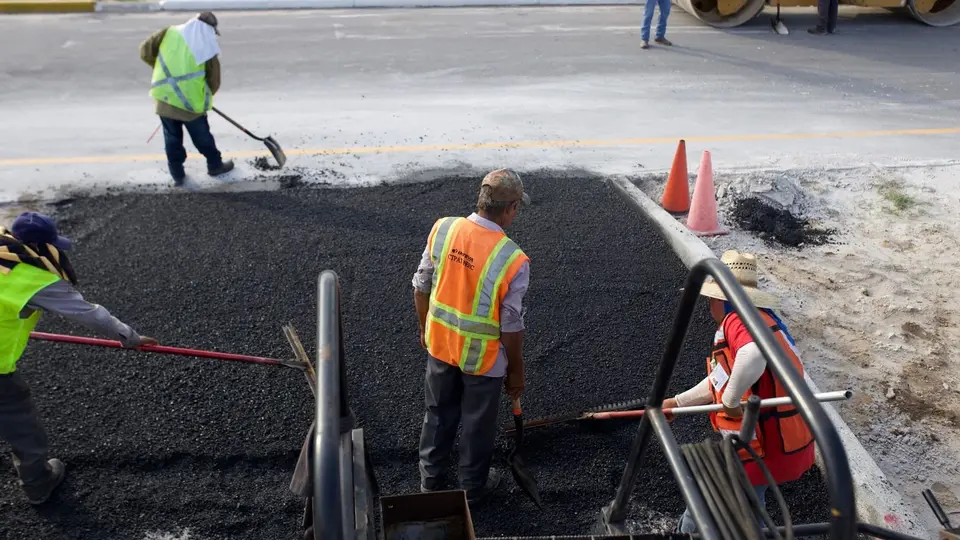
What Gets Built, in Order
A paving job is four operations, and the visible one is last. Understanding the order is most of what you need to compare two quotes intelligently, because the expensive decisions all happen before anything black arrives on site.
1. Excavation and grading
The ground is cut to depth and shaped. Shaping is not cosmetic — it establishes where water will go for the life of the surface, and a surface that holds water has a countdown on it. On a Cincinnati hillside the grading question is usually where runoff leaves rather than whether it leaves; on a flat lot it is whether there is enough fall to move it at all.
2. The stone base
Graded aggregate goes down in lifts and each lift is compacted. This is the structural layer. Asphalt is flexible pavement — it carries load by transmitting it downward into the material beneath rather than spanning across itself the way a concrete slab does — so the base is doing the work and the asphalt is the wearing surface on top of it.
Southwest Ohio clay makes this the line that matters. Clay holds water and changes volume as it wets and dries, so the ground moves seasonally under whatever sits on it. More stone is the ordinary answer, and base depth is exactly where two quotes that look identical on the total stop describing the same job.
3. The binder course
On a heavier build, a coarser lower layer of asphalt goes down before the surface layer. It adds structure. On a light residential drive it is sometimes omitted, which is a legitimate choice and should be a stated one rather than a silent one.
4. The surface course, laid hot and rolled
The finish layer arrives at temperature and has to be laid and compacted before it cools out of its working range. That is the whole reason paving is seasonal here, and it is why a crew that seems to be in a hurry usually is not being careless — they are working against the mix cooling.
The Paving Season in the Ohio Valley
Roughly mid-April through late October, with both edges being weather calls rather than dates.
The binding constraint is not the crew's preference, it is supply: local asphalt plants shut down for the winter. When the plant is closed there is no hot mix available at any price. That single fact explains most of what looks like scheduling stubbornness in this trade between November and March.
Ground temperature matters as much as air temperature. A bright 55-degree day in early April with cold ground underneath is a worse paving day than an overcast 50-degree afternoon in September. A company promising a January driveway in this region is worth a second question.
Thickness — Ask for the Number
"Standard" is not a specification. What matters is the full section: how many inches of compacted stone, and how many inches of asphalt over it, with the two stated separately.
There is no single correct answer, because the right section depends on the subgrade and on what will actually drive across it. A driveway that only ever sees two cars is a different structure from one that takes a delivery truck or an RV, and both are different again from a surface over soft clay. What is not negotiable is that the numbers appear in writing before you agree.
The counterintuitive part, worth saying plainly: a thinner mat over a properly built base will outlast a thicker mat laid on soft ground, every time. If a quote is saving money, the base is where you least want it saved.
New Construction, Replacement, and Overlay
- New construction — bare ground, nothing to remove, usually the most excavation and grading because nothing has been shaped before.
- Replacement — the old surface comes out, the base is corrected or rebuilt, and a new section goes down. What widespread alligator cracking and persistent settling call for.
- Overlay — new asphalt over the existing surface. No excavation, no new base. Correct only when the base underneath is genuinely sound.
The overlay is where money gets wasted in this trade, and the failure is predictable rather than unlucky. Laid over a base that has already failed, an overlay reproduces the same crack pattern along the same lines within a season or two, because the movement underneath never stopped. You paid for a surface, and the surface was never the problem.
The useful question to put to anyone quoting an overlay is simply: what makes you think the base is sound? There are good answers. There should be one.
What Happens to the Water
Drainage is the part of a paving quote that most often goes unmentioned and most often decides how long the surface lasts.
On a flat lot the failure mode is obvious — a puddle that sits after a storm, working into the surface and eventually into the base. On a slope it is sneakier. The water leaves quickly and the drive looks fine, right up until the runoff finds an edge that was not detailed properly and starts washing material out from underneath it. Months later the pavement at the bottom of the drive, or along one side, breaks up. It looks like the asphalt failed. It did not; it lost its support.
Given how much of this county is on a grade, a quote that says nothing about where water goes is an incomplete quote.
After the Crew Leaves
New asphalt is driveable in about a day or two, and it stays soft for weeks. That is normal and it is not a defect. Practical consequences while it cures:
- Avoid parking in the same spot every day for the first few weeks, and avoid turning the wheels of a stationary car — that is what scuffs a fresh surface.
- Keep motorcycle and trailer jack stands off it, or put a board under them. Point loads leave dimples in a soft mat.
- Expect it to look slightly different in hot sun for the first summer. It is still curing.
- Do not sealcoat it immediately. New asphalt needs to cure before it is sealed, and sealing too early traps what is still working its way out.
What Makes a Quote Comparable
Four line items turn a pile of numbers into an actual comparison:
- Stone base depth and asphalt depth, separately.
- Whether the existing surface is removed or covered, and what the removal costs.
- Drainage — pitch, edge detail, and where runoff is meant to go.
- The apron, where the drive meets the public right of way, which frequently involves the City of Cincinnati or the township and should be confirmed for your address rather than assumed.
For what any of this typically costs, the Cincinnati driveway cost guide works through the square-foot ranges and a full example.
Asphalt paving — FAQ
How long does an asphalt driveway last in Cincinnati? Twenty years or more when it is built on a properly graded and compacted base and maintained. The base is what sets that ceiling. A surface laid over ground that was not prepared will start reporting the problem in three to five years no matter how good the asphalt itself was, which is why base depth is the line item worth reading twice.
What months can asphalt be laid here? Roughly mid-April through late October, with both edges being weather calls rather than dates. The binding constraint is supply: local asphalt plants close for the winter, and when the plant is closed there is no hot mix at any price. Ground temperature matters as much as air temperature, so a cold-ground day in early April can be a worse paving day than an overcast afternoon in September.
How thick should the asphalt be? Ask for the whole section rather than one number: inches of compacted stone base and inches of asphalt, stated separately. The right answer depends on the subgrade and on what will actually drive across it, and southwest Ohio clay generally calls for more base than a sandy soil would. A thinner mat over a properly built base outlasts a thicker mat on soft ground every time.
How soon can I drive on it? About a day or two, and it stays soft for weeks after that. That is normal rather than a defect. While it cures, avoid parking in the identical spot daily, avoid turning the wheels of a stationary car, and keep jack stands and trailer jacks off it or put a board underneath — point loads dimple a soft mat.
Can you pave over my existing driveway? Sometimes, and only when the base underneath is genuinely sound. An overlay is meaningfully cheaper because there is no excavation and no new base. Laid over a base that has already failed, it reproduces the same cracking along the same lines within a season or two. The question worth putting to anyone quoting an overlay is what makes them believe the base is good — there are good answers, and there should be one.
Do I need a permit? It depends on the jurisdiction and what is being done. Replacing a surface in kind is treated differently from adding new pavement, expanding a driveway, or touching the apron where it meets the public right of way — that last one commonly involves the city or the township regardless of the rest. Requirements differ between the City of Cincinnati and the surrounding townships and should be confirmed for your specific address.
More on paving in Cincinnati
Request a free written quote
Tell us the address and what you are looking to have done. Ask for the quote in writing with the thickness and the base work spelled out, so you can compare bids on the same terms.
Prefer to talk it through? Call (513) 586-4731.